
Daniel Komen’s 3000m best of 7:20.67 was one of the oldest and toughest world records in the books. When the Kenyan achieved the time in Rieti in September 1996, he took almost five seconds off Noureddine Morceli’s record as he won the race by 23 seconds.
In the subsequent 28 years the mark has stood the test of time with Hicham El Guerrouj coming closest with 7:23.09 in Brussels in 1999 and Jakob Ingebrigtsen running 7:23.63 in Eugene last year. Even the great Haile Gebrselassie could only manage 7:25.09 with Kenenisa Bekele’s best 7:25.79.
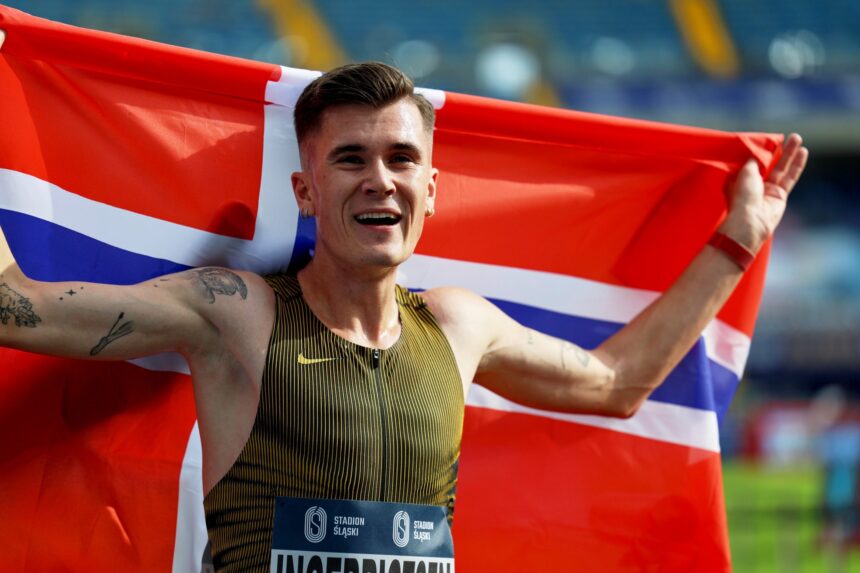
Racing at the Diamond League in Silesia, Poland on Sunday, August 25, though, Ingebrigtsen took Komen’s record apart from a magnificent 7:17.55.
Last year Ingebrigtsen took four seconds off Komen’s world two miles record from 1997 with 7:54.10 but the 3000m mark was considered much stronger.
Pieter Sisk of Belgium was the first pacemaker and he led through 1000m in 2:27.06 compared to Komen’s 2:25.89. Sisk stepped aside after one mile with the second hare, Vincent Ciattei of the United States, taking Ingebrigtsen almost to 2000m, with Ingebrigtsen moving into the lead for the first time as he passed that point in 4:55.21 compared to Komen’s 4:53.18.
At this point Ingebrigtsen was slightly behind Komen’s splits but the Norwegian was just beginning to wind up his finish and, crucially, was being pressed from behind by firstly Yomif Kejelcha and then, as the runners went into the final 600m, Berihu Aregawi.
Whereas Komen ran his penultimate lap in Rieti in 59.7, Ingebrigtsen ran a brilliant 57.46. It mean Komen’s split with 400m to go was 6:21.58 but Ingebrigtsen was now slightly quicker with 6:21.10.
The fact Ingebrigtsen had started more conservatively than Komen in 1996 was now beginning to tell. Komen’s first two laps back then were passed in 57.6 and 1:57.0, whereas Ingebrigtsen ran 59.54 and 1:58.18 on Sunday.
With Aregawi, the Olympic 10,000m silver medallist, still chasing hard a few metres behind, Ingebrigtsen wasn’t allowed to totally relax. On the final bend he took a glance behind to make sure he was clear and then powered through the final 100m to draw further away from the Ethiopian. With a last lap of 55.45 he had an uncharacteristic grimace across his face but that turned into a big smile when he saw that he had obliterated the record.
“It feels special, amazing,” said Ingebrigtsen. “I was hoping to challenge the world record here, but based on my training, I can never predict exactly what kind of time I am capable of. I would not have imagined I could run 7:17, though.”
After finishing outside the medals in the Olympic 1500m final – and winning Olympic 5000m gold in Paris – Ingebrigtsen’s post-Olympic racing period has now included the defeat of Olympic champion Cole Hocker over 1500m in Lausanne and now a world record in what is surely the 23-year-old’s sweet spot.
Runner-up Aregawi ran an Ethiopian record of 7:21.28 to go No.3 on the world all-time rankings as Kejelcha held on to clock 7:28.44.
“At the beginning the pace felt really fast,” Ingebrigtsen added, “but then I started to feel my way into the race and found a good rhythm. The 3000m is a tough distance. After four or five laps you feel the lactic acid, but you need to get going.
“The conditions were difficult with the heat today, but it is the same for everyone. I have a good team. We use ice vests, we make sure I stay hydrated and I am prepared.
“This meeting is great. The organisers make sure we feel appreciated and are comfortable and that really allows us to perform. Now I want to challenge world records at all distances, but it is one step at a time.”
Source: AW